

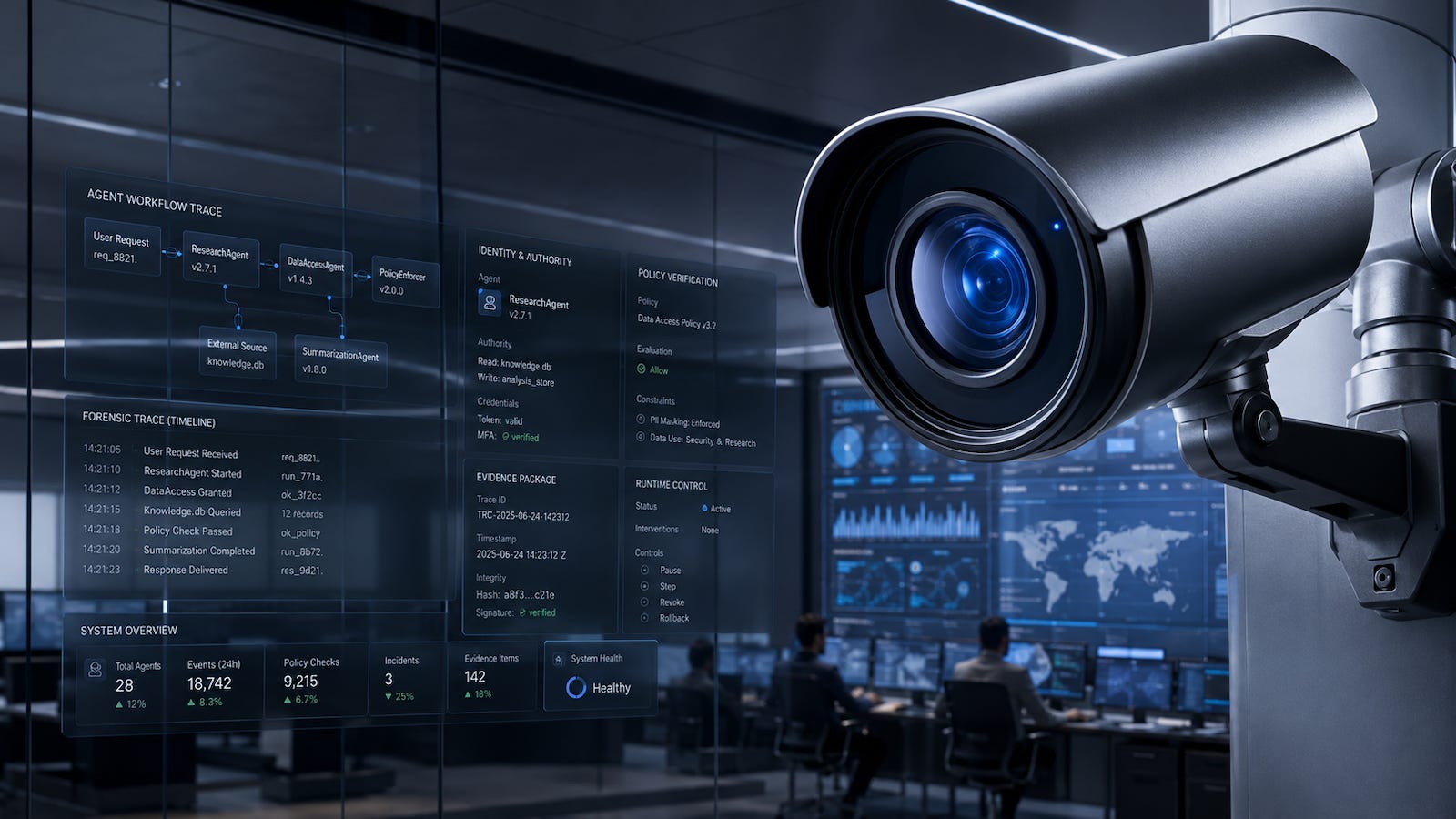
AI observability has officially gone mainstream. Finally.
For me, it has been more than seven years in the making. We saw this problem back in the digital twin and machine-learning days, with AI running across the enterprise without anyone having a complete picture of what it was doing or how to scale it. At least then, the AI was largely contained, centrally managed and limited to sophisticated but narrow deployments.
Fast forward to today and we have a fashionable new euphemism: Shadow AI. It is largely the same problem that has frustrated CIOs and CISOs for years, except this time the shadow operation is armed with extraordinarily powerful models, access to corporate data and a growing ability to act without waiting for a human.
Cloud platforms and hyperscalers are now marketing agent-monitoring dashboards. So-called observability vendors are scrambling to roll out dedicated LLM gateways, scanners and monitoring products. The open-source community is reacting as well, attempting to standardize how model calls, prompts, tool use, token consumption and other generative AI activity should be recorded.
This is exciting, if chaotic, progress. It is also exactly where the industry is about to make a very expensive mistake.
Right Problem. Wrong Architecture
AI observability is rapidly becoming another exercise in collecting bits and pieces, feeding them into a dashboard and asking analysts to reconstruct what probably happened. The charts are getting slicker, the traces are getting more colourful and vendors are becoming remarkably good at making fragmented activity look exciting.
But collecting more noise does not create insight into reality. It does not provide the foundation for real-time operational visibility, and it is nowhere close to producing a forensic record that can prove what actually happened.
There is observability, and then there is forensic evidence. The security industry may loosely talk about the two as though they are interchangeable, but they are not.
Observability captures signals surrounding an event. Anyone who has spent time on the OT side of the fence understands the problem immediately. The telemetry may be necessary, but the volume of it can quickly drown out the signal that actually matters.
In most current AI architectures, observability means piecing together model interactions, application events, infrastructure logs and SIEM alerts after the activity has already occurred. Forensic tracing is fundamentally different. It preserves the actual sequence of identity, authority, activity, dependencies, policy decisions and outcomes while the workflow is executing.
The signal-to-noise problem has long been understood in operational environments. What is coming with agentic AI is an entirely new scale of operational monitoring that is about to shock and awe an IT industry still trying to solve the problem with dashboards and log correlation.
With conventional software, the distinction was mostly an operational headache. With autonomous AI, it is the difference between having hard evidence and having a very expensive pile of JSON with no real insight into what your machine workforce was actually doing.
The Log-Stitching Delusion
Traditional observability was designed for comparatively predictable systems. Applications call services. Services call databases. Infrastructure emits metrics. When something slows down or fails, the operations team follows the breadcrumbs to answer the familiar technical question: What broke?
That is no longer the hard question.
With agentic AI, you need to know which agent acted, how it acted, under whose authority it acted and whether it continued to behave in accordance with its instructions, policies and declared purpose. You need to understand drift, isolation, collaboration, consensus, memory, delegation and outcomes.
You are no longer simply monitoring whether a technical component failed. You are trying to understand the behaviour of a machine workforce.
That changes the audience as well. It is no longer only the SOC waiting for an alert so it can respond to an incident. Process auditors, regulators, business leaders and the board are going to demand visibility and accountability. More importantly, they are going to demand proof that you actually have it.
The current industry answer is to instrument every component and stitch the logs together. Anyone who has been down the SIEM path knows how that story ends. You get a rat’s nest of dependencies across applications, identities, networks and infrastructure, followed by a consulting engagement to explain why the dashboard still cannot answer the question everyone cares about.
With agentic AI, the rat’s nest becomes infinitely worse. Activity now spans agent frameworks, orchestration pipelines, model gateways, vector databases, identity systems, memory layers, APIs, applications and security platforms.
Then layer in Shadow AI, those cute but brittle AI-assisted agents being independently deployed across the business, unsanctioned tools and employees connecting public models to corporate information. At that point, the architectural strategy shifts from “continuous visibility” to “good luck.”
Agent Demos and Hollywood Theatre
Most agent demonstrations make this problem easy to ignore because they are wonderfully clean. They paint an exciting picture of the future of business. According to certain social media feeds and conference-panel discussions, they are also remarkably fast to build, easy to deploy and immediately game-changing. An agent receives a request, calls a tool, produces a brilliantly articulated answer and everyone nods as though they have just witnessed the future of enterprise automation.
Just look at all the code my agent wrote while I sat here pondering this article. Those who know me will recognize that as a not-so-subtle sarcastic remark.
In my recent conversations with enterprises and governments, that facade has started to fall away, although not nearly as quickly as it should. I still find myself in uncomfortable discussions with pundits insisting they can go it alone: DIY, we’re good, we have it handled, our forward-deployed engineers are “vibing.”
Yes, apologies, that was another dig.
One government entity recently put its assessment more bluntly. Its view was that most vendors possess perhaps 20 percent of the capabilities their demonstrations, marketing and product literature imply.
Put another way, the demos are 80 percent BS. That should make every enterprise buyer cringe.
Production is not one agent following one clean path through one model. Enterprise and government workflows involve many agents, thousands of tasks, several models, changing execution paths, retries, human approvals, policy checks, web searches, internal files, databases, memory operations and downstream system actions.
Some activities happen sequentially while others happen concurrently. An agent can fail without causing the overall workflow to fail, recover on retry and then follow an entirely different path. An intermediate result can be consumed by several agents, transformed repeatedly, stored in memory, written to a collection and eventually transmitted into another system.
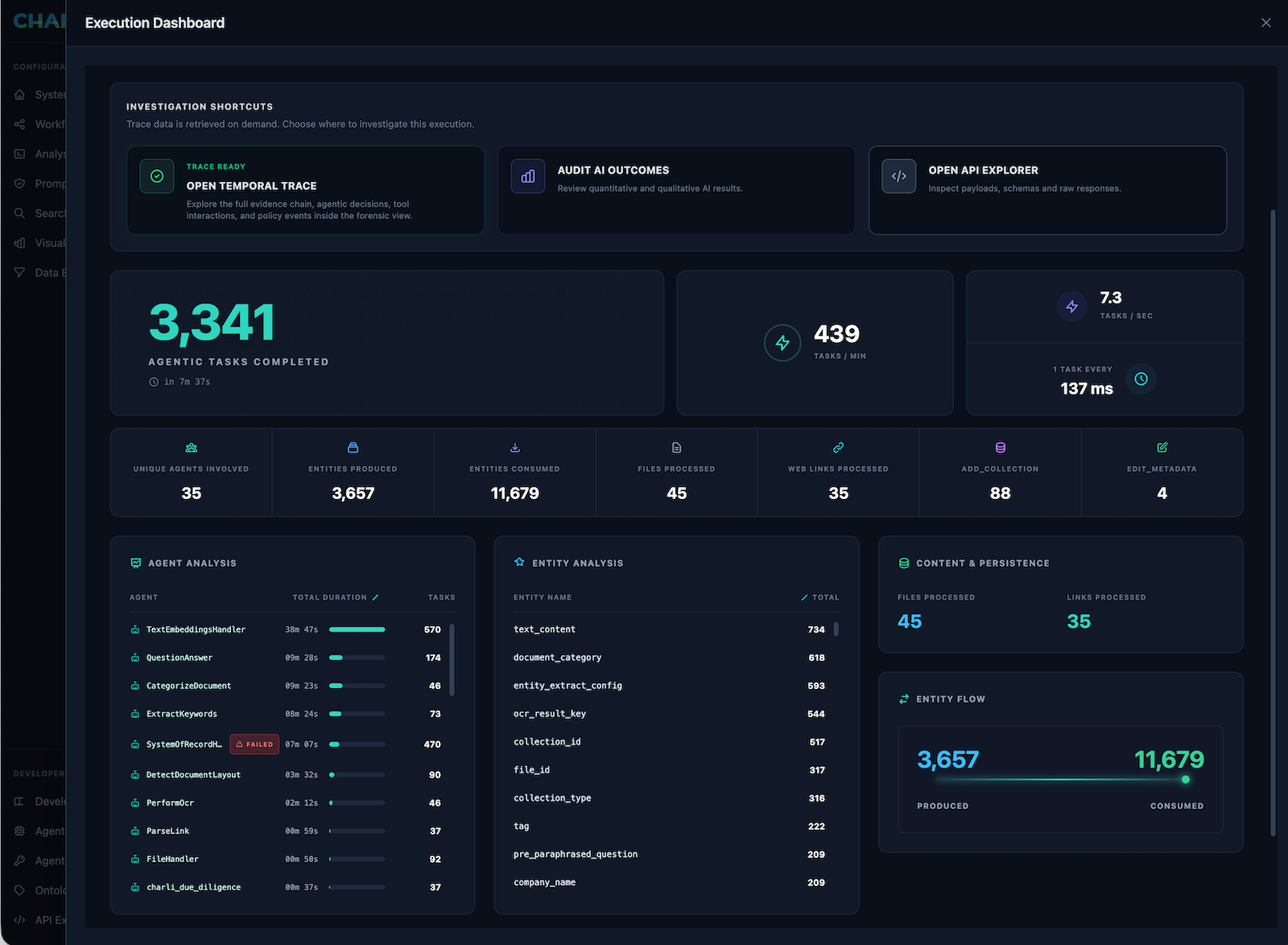
In our standard customer workflows, we easily see more than 35 agents completing over 10,000 tasks and billions of underlying operations as they gather, parse, collaborate, process and produce information within a single workflow. Then repeat that across thousands of workflows. That is not theatre or Hollywood staging. It is what is already happening in production.
And once again, good luck stitching it all together from infrastructure logs after something goes wrong.
Machine Speed Catastrophe in the Making
Enterprise automation is the name of the game. It is the reason agentic AI exists. Now consider how that automated workforce will operate continuously at machine speed. For many practitioners, that prospect is overwhelming. For anyone who has spent time on the OT side of the fence, it looks more like a typical Tuesday.
Static filters, alerts and stitched logs will continue to catch known technical conditions. They can identify latency, errors, token spikes, prohibited API calls and certain types of sensitive data crossing a boundary. They remain useful inputs to security operations and incident response.
But those methods were built to recognize known events. They were not designed to explain how instructions became tasks, how those tasks were delegated, how data became an intermediate entity, how that entity influenced another agent, how policy altered the execution path or how thousands of individual actions accumulated into a final outcome.
That requires more than telemetry. It requires lineage, context and forensic evidence.
This is where the OT comparison becomes important. The digital twin industry was never simply about watching machines generate data. It was about using operational context to detect anomalies, predict failures, plan activity and improve efficiency across complex systems.
Agentic AI presents the same fundamental challenge at a much greater scale. The real issue is not the GenAI interface, the LLM or the incremental productivity gain for an individual employee. It is the operation of an autonomous workforce moving across enterprise systems at machine speed.
Capturing a prompt and response is not lineage. That is what a straightforward MCP gateway gives you. The rest of the heavy lifting is left to the enterprise, usually in the form of millions of dollars in forward-deployed engineering to build the agents, instrument the pipelines and effectively construct an AI SOC from the ground up.
Even after all that bespoke work, the enterprise is still trying to bolt visibility onto an adaptive system already operating at machine speed. The likely result is not control. It is a mountain of technical debt wrapped around an incomplete view of the workflow.
Observability Has a Business Blind Spot
The visibility problem is not confined to cybersecurity. It becomes painfully obvious when the invoice arrives.
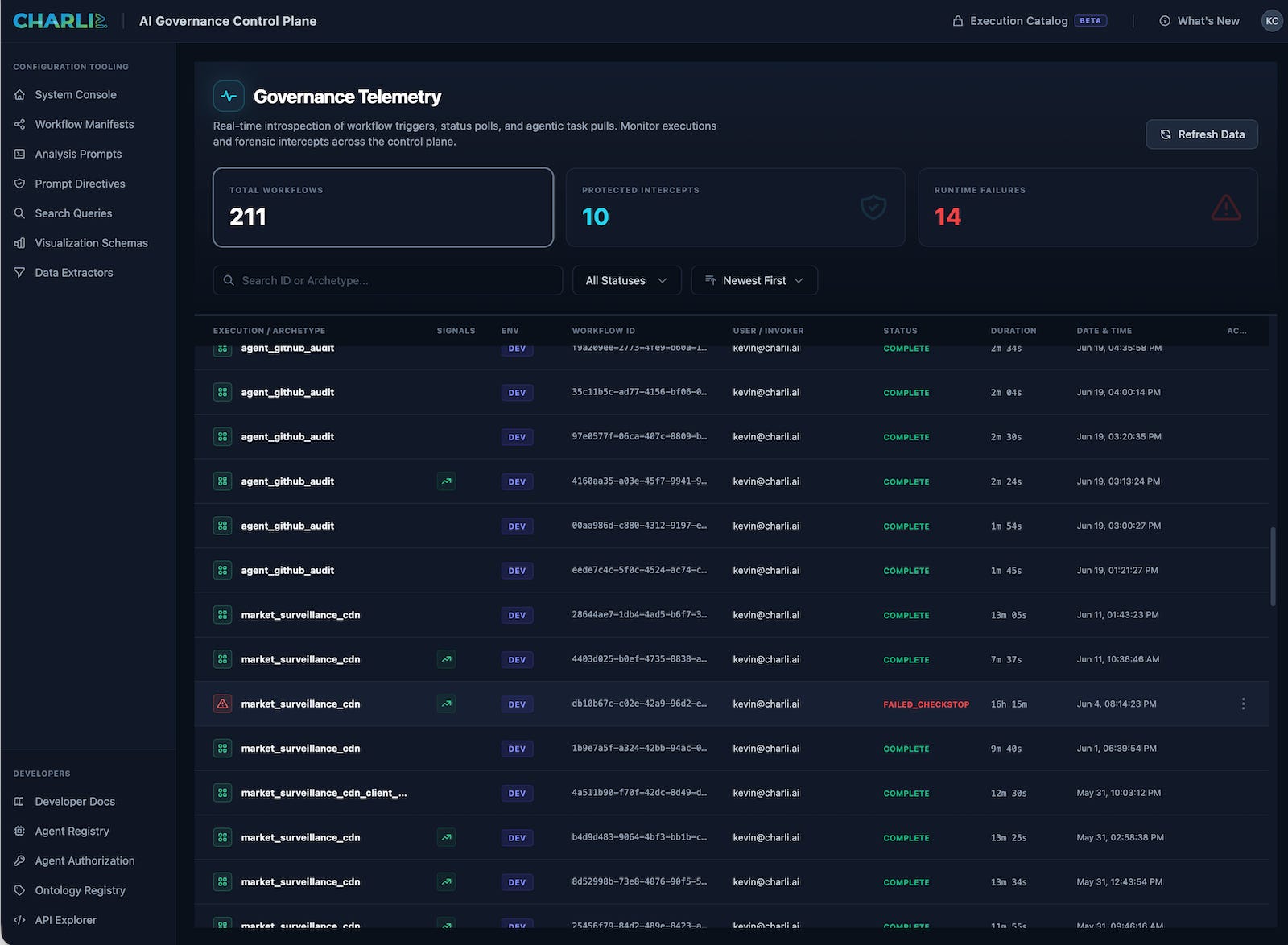
A model provider can report token consumption. A cloud platform can report compute usage. An observability dashboard can show latency and request volume. None of that explains why the workflow cost what it did, which agents consumed the resources, how many retries occurred or whether the outcome justified the expense.
Without a forensic trace connecting resource consumption to operational activity, AI cost management becomes forensic accounting. The enterprise gets the bill first and starts searching for an explanation afterward.
The Control Plane Is Operational Truth
AI observability is ultimately dependent on the control plane. You can have standards around OpenTelemetry and more standards around MCP, A2A, but the control plane is where operational transparency is going to come from.
The control plane already sits in the flow of execution. It can know the agent’s identity, declared purpose, assigned task, available authority, dependencies and permitted actions. It can observe the information entering and leaving each stage. It can enforce policy while preserving evidence of what was evaluated, what decision was made and how that decision affected execution.
A forensic control plane does not watch the parade from the sidewalk. It controls the intersection. Logs from surrounding systems remain valuable. SIEMs remain valuable. Identity platforms, data-security tools, network systems and application logs all provide important corroborating evidence. But they see fragments.
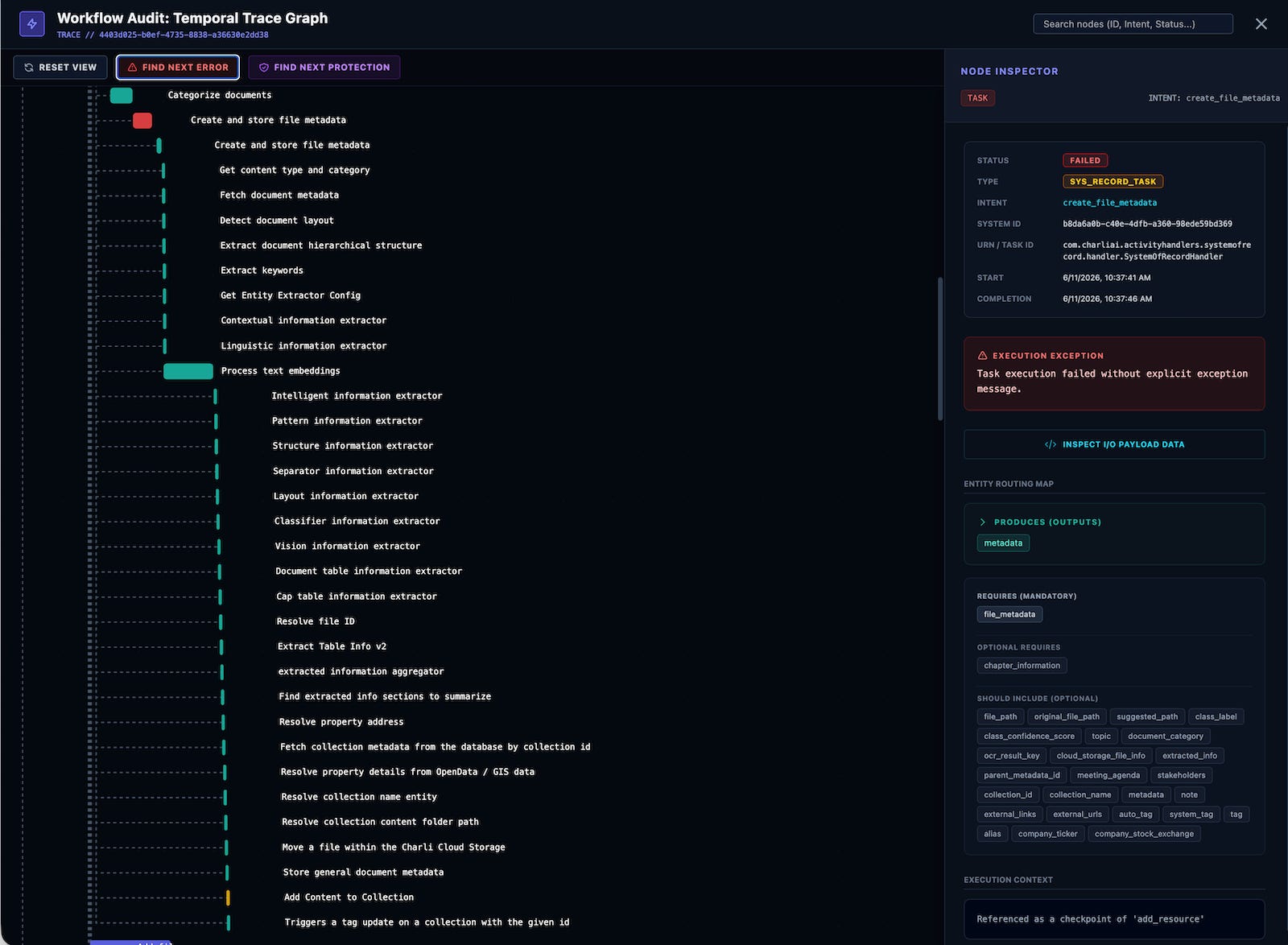
The control plane is uniquely positioned to preserve the workflow as a coherent temporal execution record rather than a collection of technical events that may or may not relate to one another. This is where observability becomes operationally useful across the enterprise: temporal tracking, dependency tracking, agent introspection, entity lineage, policy attribution, cost attribution and direct linkage to agent identities, profiles and enterprise knowledge.
Instead of looking at millions of disconnected flows and billions of isolated operations, the enterprise can understand how they relate to a specific workflow, objective, authority and outcome.
The SOC of the Future Looks More Like OT
The future of AI operations is going to look far more like OT than traditional IT. OT environments have spent decades managing complex systems that operate continuously, interact dynamically and generate enormous volumes of activity at machine speed. They learned long ago that collecting more events is not the same as understanding the operation.
Agentic AI is now forcing the IT and cybersecurity industries to learn the same lesson. Agents are not servers, applications or static microservices. They are an automated workforce being assigned objectives, granted authority, supplied with tools and permitted to act across enterprise systems.
You do not manage that workforce by counting model calls and network packets. You manage it through identity, delegated authority, operational context, policy and evidence.
Unfortunately, much of the observability market continues to monitor agents as though they are simply another application stack. That is the category error.
The SOC does not need another dashboard telling it that something unusual happened. Security teams need to know who acted, under what authority, what information was used, which path was followed, which policies were applied, what changed and what happened next.
Operations teams need to understand performance and failures. Developers need to diagnose execution paths. Risk and compliance teams need evidence. Finance needs cost attribution. Business leaders need to know whether the automation accomplished anything useful.
Forensic tracing is what connects those requirements.
AI observability is becoming mandatory, and that is a good thing. But instrumentation alone will not provide control, and log correlation will not deliver the visibility, accountability or proof the enterprise now requires. Dumping more JSON into a SIEM and asking analysts to reverse-engineer the truth is not the future of AI observability.
That future will be built around a runtime control plane that preserves identity, authority, policy, lineage and outcomes across every execution.
Because when an autonomous agent compromises customer data, violates policy or triggers a consequential business decision, “we found some related logs” will not satisfy the regulator, the board or the headline writers.