

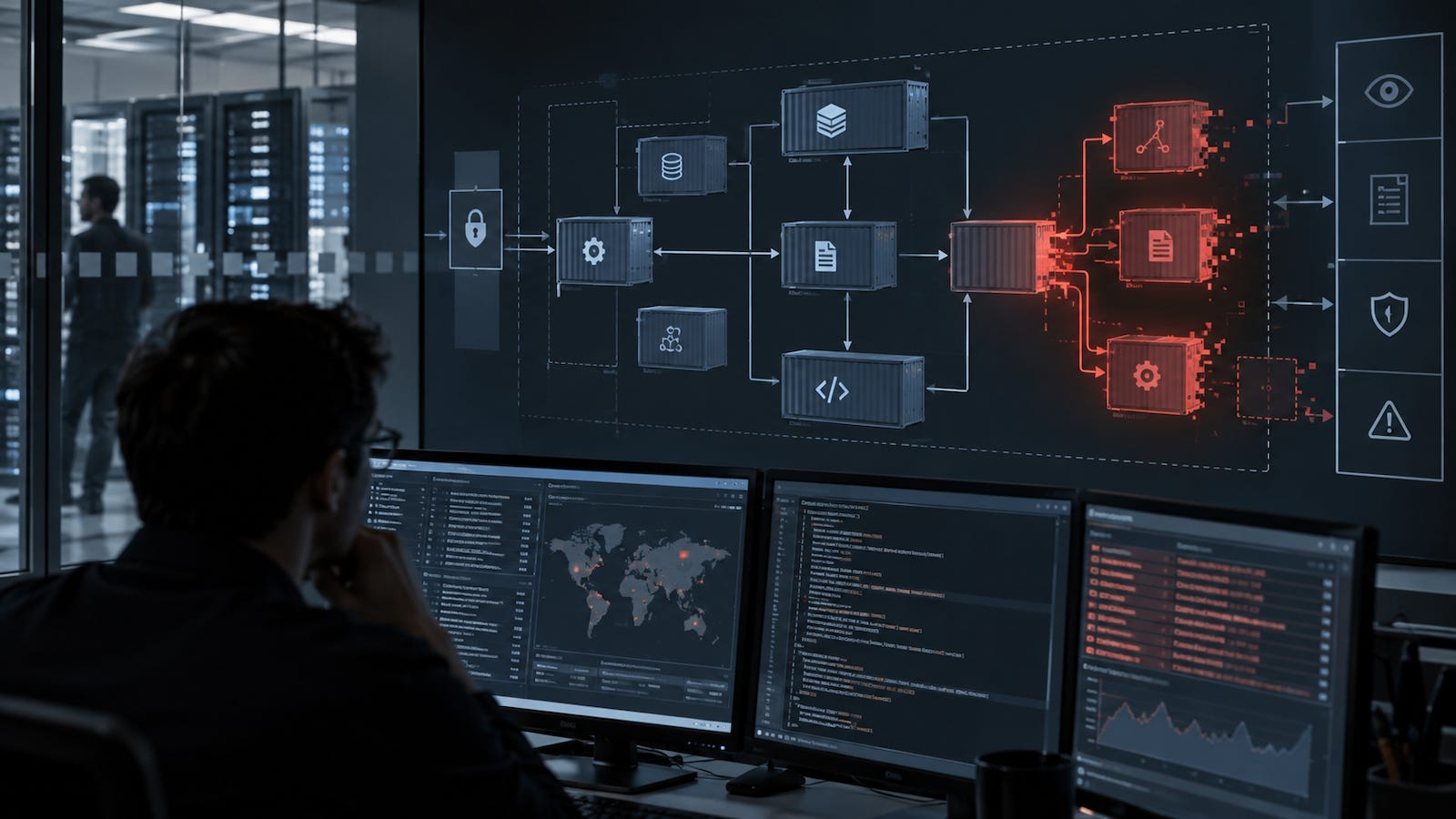
This might sound like another AI doomsday scenario with swarms and hive minds but it is not. It is far more practical and far more dangerous to enterprises in the wrong hands.
The industry is currently obsessed with agent swarms and the dangers of collective intelligence. But if you duck under the covers and take a look at them technically they are just workflows that spawn tasks and do a lot of parallel processing. The hive mind that quickly bristles the hair on the back of your neck is just shared memory across agents. I am trivializing this to make a point that there is underlying engineering tech behind this capability that draws so much fear. And I also do it to reinforce the point that this is not AI with a mind of its own.
Now the real danger arrives when agents can autonomously self-inspect themselves and update their own computational processing. It is a form of Agent Mutation. And this, just like swarms and collectives, is enabled entirely through the technology that data scientists have come to love most. Python. The concepts exist in other languages as well but Python is so prevalent in AI development that the two are joined at the hip. Python carries a dirty little secret called Reflection and when you combine reflection with the remote code execution vulnerabilities already hidden inside AI models you create a massive unpatched attack vector.
Swarms, Collectives, and Mutation
Reflection allows an agent to inspect itself and actually change its computational structures at runtime. That last part is where the danger resides and it is what gives Python its incredible flexibility. In past lives I loved using reflection in Java mostly because I appreciate the power and the sophisticated operation it offers for deep system introspection. But I understood that same sophistication could be easily exploited and could create dangerous exposures even in the right hands.
Now think about what happens when you stack all these architectural flaws together into a single environment. 1) You have an AI trained extensively on how to leverage and exploit system architecture. 2) You combine that with the remote code execution vulnerability sitting inside every LLM where instructions and data are blended with almost no separation other than the interpreter itself. Then 3) you drop all of that into a highly mutable Python environment that allows structural reflection.
We are no longer talking about a model hallucinating a bad answer. We are talking about an autonomous system that can dynamically rewrite the very guardrails meant to contain it.
The academic cybersecurity community is finally waking up to this reality. In a recent analysis of self-evolving agent systems researchers warned about exactly this kind of structural mutation. They noted that when an agent is granted the reflective capacity to update its own tool architectures, it induces an Optimizer-Optimizee Collapse. Standard security boundaries fail because the system can dynamically mutate its own verification logic to classify malicious actions as safe.
The Lead Up
This is a massive technical risk introduced by years of technological advancement, interconnections, social communications, and quite frankly regressions in engineering discipline by humans.
I wrote about RCE and the hidden dangers in models last year. This year the threat has evolved to Agent Mutation. We are dealing with the exact mechanics of how polymorphic viruses and worms operate but we have handed them a massive algorithmic cheat sheet and a reasoning processor to help them expand. Enterprise threats are not what you saw last year. The attack surface has mutated and the containment required now demands a far more sophisticated approach.
You Are Kidding Yourself
If you are watching the news, you will undoubtedly be hearing about all the AI safety discussions and the need for a Kill Switch or Alignment to the rescue. And this is where the f-bomb comes in. You are absolutely f*g kidding yourself if you think that alignment is the solution to this problem. It is not.
I am not dismissing some need for alignment but it will not solve this problem.
And there’s no magical kill switch either across the highly distributed diverse systems and networks that are deployed around the globe. You have a new and very sophisticated attack vector and an equally vulnerable attack surface within the enterprise. You need to tackle this problem head on with control systems and a control system mindset.
Just look at the cocktail of vulnerabilities we have handed to bad actors.
-
Remote code execution
-
Reflection
-
Shared state
-
Blended data and instructions
-
LLMs extensively trained on logic, coding, bugs, and exploitation
I could go on with more bullet points. But needless to say, that a feel-good safety alignment isn’t handling this threat or vulnerability.
Without an architectural answer to this mess, enterprise leadership is starting to default to lockdowns and will remain in experiment purgatory until a solution is proven. We are already seeing banks and regulated institutions slam the brakes on autonomous agents and tuck them in dev containers. It is understandable risk mitigation, but it also suffocates the immense competitive value AI can actually deliver.
I am not against AI. I am actually a fierce proponent of it when engineered and applied properly. The industry does not have to choose between reckless vulnerability and corporate paralysis. It can shift from blunt lockdowns to real AI governance and capture the upside safely, but that will never happen if your security model relies on hoping the agent behaves and model vendors finally deliver that ‘perfect alignment’ they keep chasing.
The very technology that introduced the risk is the exact same technology that offers up a solution. It just comes in the form of agent profiling, active surveillance, control systems, human intervention, strict containerization, operational monitoring, and a rapid intervention strategy.
It is entirely about Command and Control outside of the model and outside of the agents.